
35+ Reviews

The Ultimate Guide to Tick Prevention: Avoiding Lyme Disease and Our Natural DIY Tick Spray
Shelly Skorik
May 20, 2026
As the weather warms up and we spend more time enjoying the great outdoors, we also enter the prime season for one of nature’s most persistent pests: the tick. While they may be tiny, ticks pose a significant threat to our health.
Understanding where ticks live, how they behave, the dangers they carry, and what to do if you get bitten is the first step in protecting yourself and your family. In this guide, we will break down everything you need to know about tick prevention, avoiding Lyme disease, and how to make our favorite natural tick spray right in your own kitchen.
Where Do Ticks Live and How Do They Behave?
To avoid ticks, you need to know where they hide. Ticks thrive in moist, humid environments. You will most commonly find them in:
- Wooded and heavily forested areas
- Tall brush and grassy fields
- Leaf litter and low-growing shrubs
- The transitional edges where the woods meet the lawn
Tick Behavior: The Art of “Questing” A common misconception is that ticks jump or fly from trees. In reality, ticks cannot fly or jump. Instead, they wait for a host using a behavior called “questing.” A tick will hold onto a blade of grass or a leaf with its lower legs while leaving its upper legs outstretched. When a human or animal brushes past, the tick quickly grabs on and climbs upward, looking for a warm, safe place to attach and feed.
The Dangers of Tick Bites and Lyme Disease
Ticks are dangerous because they are highly effective vectors for disease. When a tick bites, it can transmit pathogens from its saliva into your bloodstream.
The most well-known and prevalent threat is Lyme disease, caused by the bacterium Borrelia burgdorferi (transmitted primarily by the black-legged tick, or deer tick).
Why Lyme Disease is Dangerous: If left untreated, Lyme disease can cause severe, long-lasting health issues.
- Early Symptoms: Fever, chills, fatigue, muscle and joint aches, swollen lymph nodes, and a characteristic “bullseye” skin rash (Erythema migrans).
- Long-Term Effects: If the infection spreads, it can cause severe joint pain and swelling (often in the knees), neurological problems (like facial palsy or neuropathy), cognitive decline, and heart palpitations.
Because ticks secrete a numbing agent when they bite, you often won’t feel them. This is why vigilance and prevention are absolutely vital.
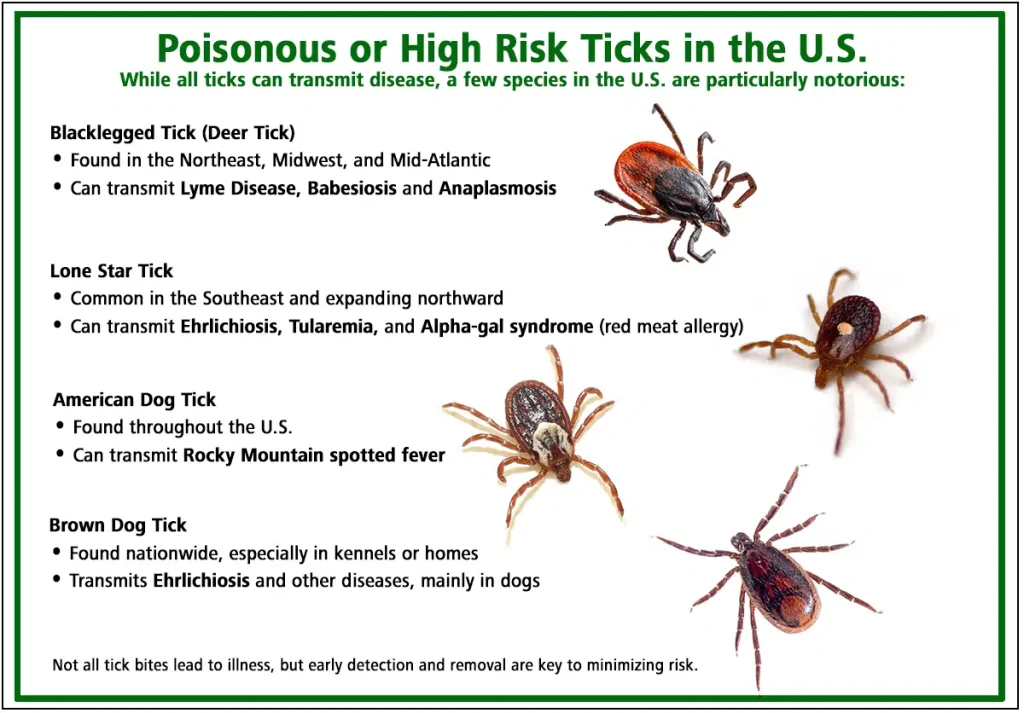
How to Prevent Tick Bites
You don’t have to avoid the outdoors to stay safe. Follow these simple steps—along with applying a natural tick spray—to minimize your risk of a tick bite:
- Dress Smartly: Wear light-colored clothing so ticks are easier to spot. Wear long sleeves and tuck your pants into your socks to prevent ticks from crawling up your legs.
- Stay on the Trail: When hiking, walk in the center of the trail and avoid brushing against tall grass or overgrown bushes.
- Perform Daily Tick Checks: After spending time outdoors, check your entire body. Pay special attention to hidden areas like the scalp, behind the ears, under the arms, inside the belly button, behind the knees, and around the groin.
- Shower Immediately: Taking a shower within two hours of coming indoors can help wash off unattached ticks.
- Protect Your Pets: Dogs and cats can easily bring ticks into the home. Talk to your vet about tick prevention products and check your pets daily.
What to Do If You Get Bitten: How to Properly Remove a Tick
Even with the best prevention, tick bites can still happen. If you find a tick attached to your skin, do not panic, but act quickly. The longer a tick is attached, the higher the risk of disease transmission (it typically takes 36 to 48 hours for the Lyme disease bacterium to be transmitted).
Here is the safe and proper way to remove a tick:
- Use Fine-Tipped Tweezers: Grab a pair of clean, fine-tipped tweezers.
- Grasp Close to the Skin: Get the tweezers as close to your skin’s surface as possible to grab the tick’s head or mouthparts.
- Pull Straight Up: Pull upward with steady, even pressure. Do not twist or jerk the tick, as this can cause the mouthparts to break off and remain in the skin. If this happens, try to remove the mouthparts with tweezers. If you can’t, leave it alone and let the skin heal.
- Clean the Area: Once the tick is removed, thoroughly wash the bite area and your hands with rubbing alcohol or soap and water.
- Dispose of the Tick: Never crush a tick with your bare fingers. Dispose of a live tick by putting it in a sealed bag/container, wrapping it tightly in tape, or flushing it down the toilet. Tip: If you want to have the tick tested for diseases, place it in a small ziplock bag or a sealed jar with a damp cotton swab and contact your doctor or local health department.
What NOT to Do: Never use old folklore remedies like painting the tick with nail polish, covering it in petroleum jelly, or using heat/matches to make the tick detach. These methods can actually agitate the tick and cause it to regurgitate infected saliva into your bloodstream.
How to Make Your Own Natural Tick Spray
If you prefer to avoid harsh chemical bug sprays like DEET, using a natural tick spray is a highly effective alternative. Certain essential oils naturally repel ticks, confusing their senses and keeping them away from your skin.
Ingredients:
- 3 Tbs Witch Hazel (acts as the base and helps disperse the oils)
- 3 Tbs Water (distilled or boiled and cooled)
- 1 Tbs fractionated Coconut Oil (helps the spray stick to your skin/clothes and acts as a moisturizer)
- 8 drops Lemon essential oil
- 8 drops Eucalyptus essential oil
- 8 drops Cedarwood essential oil
- 4 drops Citronella essential oil
- 4 drops Geranium essential oil
- 3 drops Peppermint essential oil
Makes one 4oz Spray bottle
Instructions:
- Combine: In a clean, dark glass spray bottle (dark glass helps preserve the essential oils), combine the witch hazel, water, and coconut oil.
- Add Oils: Carefully drop in the lemon, eucalyptus, cedarwood, citronella, geranium, and peppermint essential oils.
- Shake Well: Oil and water naturally separate, so you must shake your natural tick spray vigorously before every use.
- Apply: Spray generously on your clothing, shoes, and exposed skin before heading outdoors. Avoid spraying directly on your face or near your eyes (spray into your hands and dab onto your neck if needed). Reapply every 2 hours or after heavy sweating.
Note: Always do a small patch test on your skin first to ensure you don’t have an allergic reaction to any of the essential oils. Consult a pediatrician before using essential oils on young children.
By understanding how ticks operate and taking a few proactive steps—like using a protective natural tick spray, doing routine tick checks, and knowing how to safely remove them—you can enjoy nature safely and keep Lyme disease at bay.
Share & follow
For any inquiries, please contact:
Shelly Skorik
Email: thatnaturalplace@gmail.com
Facebook: thatnaturalplace
Instagram: thatnaturalplace
Similar Posts
Shelly Skorik
May 20, 2026
The Ultimate Guide to Tick Prevention: Avoiding Lyme Disease and Our Natural DIY Tick Spray
As the weather warms up and we spend more time enjoying the great outdoors, we also enter the prime season...

Shelly Skorik
May 17, 2026
Advanced Fulvic Acid: Supporting Detox, Gut Health, Energy, and Overall Wellness
In today’s world, our bodies are constantly exposed to environmental stressors, processed foods, pollutants, and everyday toxins that can impact...

Shelly Skorik
May 4, 2026
Natural Healing vs Modern Medicine: When to Use Each (From a Nurse of 30+ Years)
In today’s world, health advice comes from every direction. Some voices emphasize pharmaceuticals and procedures. Others point toward herbs, nutrition,...

Shelly Skorik
May 1, 2026
Finding Peace in a Frantic World: The Complete Guide to AnxioCalm & Anxiety
In our fast-paced world, stress and anxiety are daily companions for millions. From work deadlines to family demands, the pressure...

Shelly Skorik
March 27, 2026
A Gentle Approach to Body Transformation and The Complete Guide to the Zerona Z6 Laser
Non-invasive options for fat loss continue to grow in popularity, especially for people who want something gentle that does not...

Shelly Skorik
March 18, 2026
Biomat Therapy: The Holistic Solution for Pain Relief, Detox, and Deep Relaxation
If you’re looking for a natural way to relax, recover, and reduce physical discomfort, Biomat therapy could be the holistic...
Shelly Skorik
March 16, 2026
Infrared Sauna Therapy: Deep Relaxation and Powerful Health Benefits
Many of us seek ways to de-stress, manage pain, and enhance our overall well-being. Traditional saunas offer warmth, but their...
Shelly Skorik
March 10, 2026
Avazzia Microcurrent Therapy: A Game-Changer in Natural care
“What if there was a gentle, drug-free way to activate your body’s innate ability to heal and find lasting pain...
Shelly Skorik
March 9, 2026
Qest 4 Analysis: Unlock Your Body’s Hidden Wisdom for Root Cause balance
“What if your body could tell you exactly what it needs to heal?” This powerful question is profoundly changing how...

Shelly Skorik
March 4, 2026
Best Holistic Wellness Services in Port Washington, Wisconsin
Discover Natural Healing and Whole-Body Wellness In recent years, holistic wellness has become an increasingly popular approach to health for...